
TEMPEST and RF Shielding Design, Testing, and Compliance | SSU
Did you know that every electronic device release faint electromagnetic signals? If organizations fail to control these signals, adversaries can intercept and decode them. Therefore, TEMPEST and RF shielding become essential tools for protecting sensitive information.
In today’s interconnected world, organizations must guard data more carefully than ever. Government agencies, military units, financial institutions, and research laboratories all face similar risks. For this reason, security professionals rely on TEMPEST and RF shielding to reduce electronic eavesdropping and interference. Although both concepts support security, they address different problems. However, when teams combine them, they create far stronger protection. Understanding these differences, therefore, helps leaders design truly secure facilities.
What Is TEMPEST?
Think of your computer like a tiny radio transmitter. Even when you cannot hear it, specialized equipment can capture its signals. Consequently, TEMPEST focuses on preventing this unintentional broadcast of sensitive information. The U.S. government developed TEMPEST standards, primarily through the National Security Agency, to control compromising emanations from electronic equipment. As a result, these standards guide how engineers design rooms, cables, power systems, and devices. Moreover, they establish measurable requirements for testing and certification. When organizations follow these rules, they stop attackers from reconstructing classified data. TEMPEST compliance uses graded levels of protection. Therefore, higher levels demand tighter controls, better materials, and more rigorous testing. In addition, designers must apply electromagnetic principles with great precision.
What Is RF Shielding?
RF shielding blocks or reduces radio frequency signals from passing through walls, doors, and cables. For example, engineers use RF shielding to contain internal emissions and, at the same time, to keep outside interference from entering secure spaces. For RF shielding, technicians measure attenuation in decibels across multiple frequency ranges. This data, therefore, demonstrates whether the enclosure meets TEMPEST objectives and project requirements. In addition, the results help engineers adjust designs before final accreditation.
Why Secure Facilities Need Both
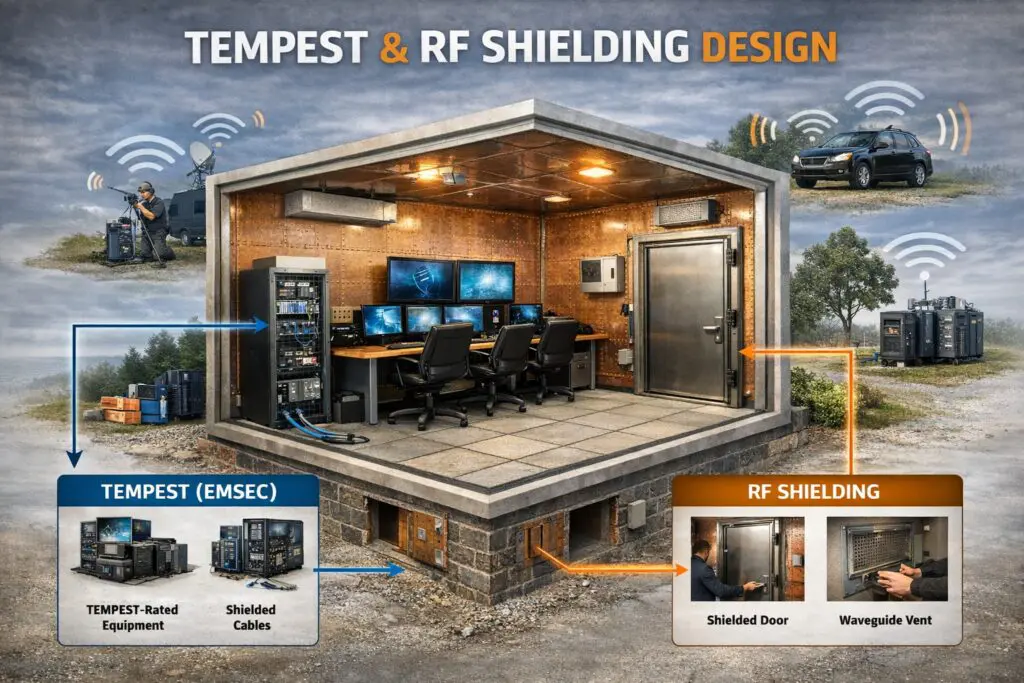
A single control rarely stops sophisticated threats. Therefore, secure facilities combine TEMPEST practices with RF shielding to create layered defense.
- TEMPEST Compliance limits the signals that equipment generates.
- RF Shielding for Containment prevents remaining signals from leaving the room.
- RF Shielding for Interference Mitigation blocks outside sources that could disrupt operations.
Together, these measures protect confidentiality, integrity, and mission assurance. Moreover, they help organizations meet federal and NATO security requirements.
Standards and Certifications
The NSA and NATO publish strict TEMPEST standards and testing methods. Accredited laboratories measure emanations and confirm that systems remain below allowed thresholds. As a result, this process gives organizations verifiable proof of security. Furthermore, it creates a repeatable baseline for future upgrades. For RF shielding, technicians measure attenuation in decibels across multiple frequency ranges. This data, therefore, demonstrates whether the enclosure meets TEMPEST objectives and project requirements. In addition, the results help engineers adjust designs before final accreditation.
Conclusion
TEMPEST and RF shielding work hand in hand to defend sensitive information. TEMPEST controls the signals that devices create, while RF shielding blocks those signals from escaping or entering. Therefore, organizations that handle classified data must address both disciplines rather than relying on only one.
By partnering with experienced specialists, leaders can design facilities that resist electronic surveillance and maintain compliance. Ultimately, a comprehensive approach protects missions, people, and national security.
Frequently Asked Questions
1. What is the main difference between TEMPEST and RF shielding?
TEMPEST reduces information leakage from equipment. In contrast, RF shielding physically blocks radio frequency signals. Therefore, organizations often use both to achieve full protection.
2. Is all RF shielding related to TEMPEST?
No. Engineers also use RF shielding to prevent interference in hospitals, labs, and data centers. However, TEMPEST programs rely heavily on RF shielding to contain compromising emanations.
3. Do I need TEMPEST if I already have RF shielding?
Yes, in most classified environments. Basic shielding may not meet TEMPEST standards. Consequently, programs typically require design reviews, testing, and certification.
4. What are compromising emanations?
Compromising emanations are unintended electromagnetic signals that carry information. For example, attackers can exploit them to reconstruct data.
5. How effective must shielding be?
Requirements depend on classification levels and risk assessments. Therefore, engineers measure effectiveness in decibels of attenuation across frequency bands.
6. Can I use off-the-shelf products?
Commercial products can help, but full compliance usually requires custom design, expert installation, and accredited testing.
External Resources
National Institute of Standards and Technology: https://www.nist.gov/
National Security Agency – cybersecurity guidance: https://www.nsa.gov/
Department of War: https://www.war.gov/